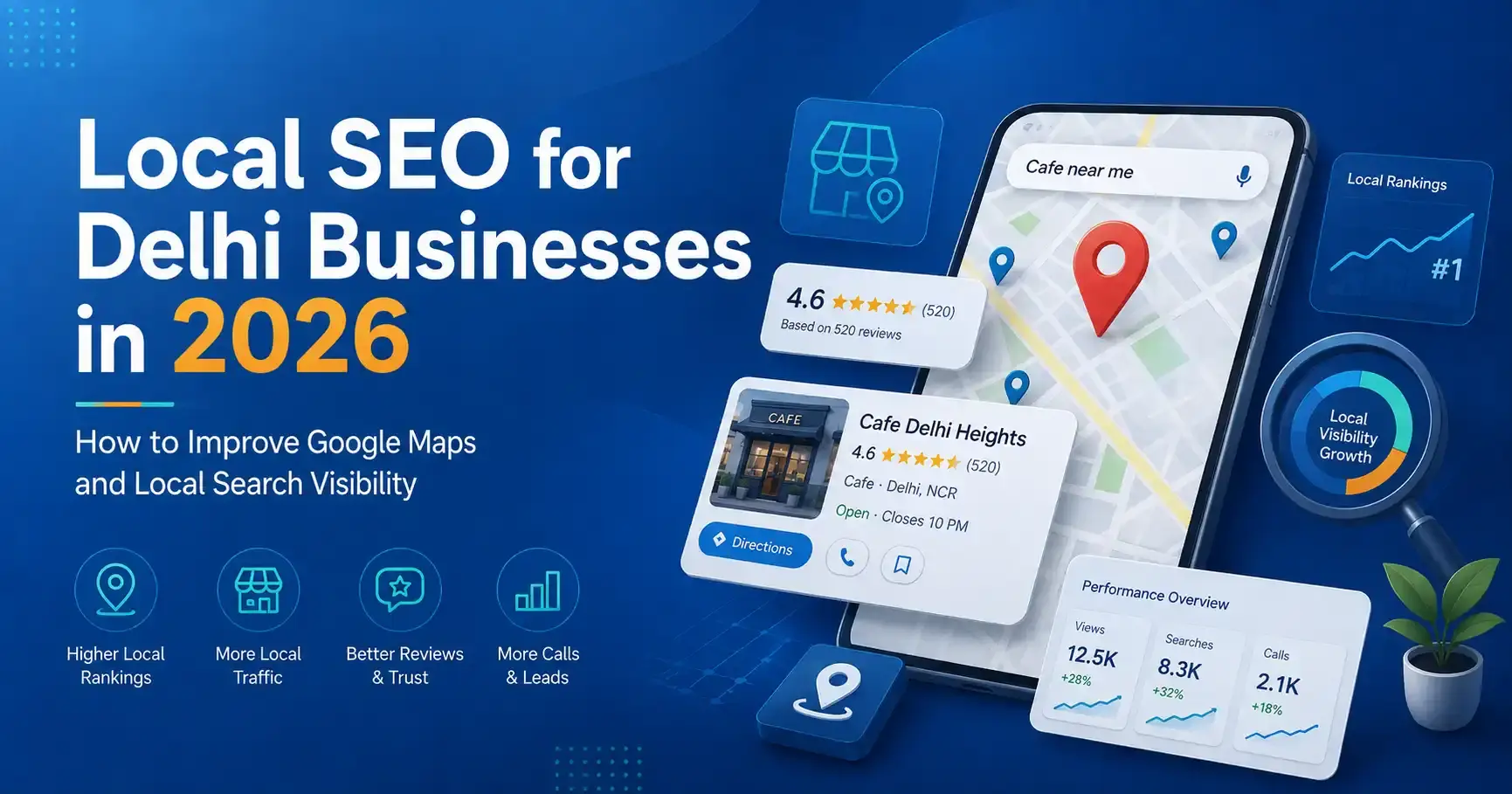
Local SEO helps a business become more visible when people search for a service in a specific area or look for nearby providers in Google Search and Maps. For a business serving Delhi NCR, that can include searches such as “website developer in Nehru Place,” “SEO company in Delhi,” “dentist near me,” “interior designer in Noida” or “accountant in Gurgaon.”
Ranking locally is not about repeating a city name hundreds of times. Google explains that local results are mainly influenced by relevance, distance and prominence. That means a strong local strategy combines an accurate Google Business Profile, a technically sound website, useful location-relevant content, real customer reputation and consistent business information across the web.
This guide explains a practical approach to local SEO for Delhi businesses in 2026 without fake reviews, doorway pages or keyword stuffing.
What is local SEO?
Local SEO is the process of improving a business’s visibility for searches connected to a geographic area. It covers both the website and external local signals such as Google Business Profile, business directories, reviews and local mentions.
For service businesses, local SEO can influence two important search surfaces:
- Google Maps / local pack: business profiles displayed for local-intent queries.
- Organic search: website pages that rank below or around the local results.
A business can perform differently in Maps and organic search, so the strategy should measure both.
The three foundations of Google local visibility
Relevance
Relevance is how closely the business matches what the searcher wants. Clear categories, services, website pages, profile information and content help search systems understand what the business actually offers.
Distance
Distance considers the location of the searcher or the location named in the query. This is why no ethical SEO provider can guarantee the same Maps position for every person across Delhi NCR. A business in Nehru Place may naturally perform differently for users searching from Rohini, Noida or Gurgaon.
Prominence
Prominence reflects how established and well known a business appears. Reviews, links, mentions, directories, website authority and broader real-world reputation can contribute to this picture.
This is why local SEO services in Delhi NCR should never be reduced to editing a Google Business Profile once. The profile and the website need to reinforce each other over time.
Step 1: make your Google Business Profile accurate and complete
Start with basic accuracy. The business name should reflect the real-world business name rather than a list of keywords. Choose the most accurate primary category and relevant secondary categories. Add genuine services, business hours, website, phone number and address or service-area information according to how the business actually operates.
- Business name.
- Primary and secondary categories.
- Address or service-area setup.
- Phone number.
- Website URL.
- Regular and special hours.
- Services or products.
- Business description.
- Attributes available for the category.
- Photos and videos.
Do not add keywords to the business name unless they are genuinely part of the name used in the real world. Short-term manipulation can create verification or policy problems.
Step 2: keep NAP information consistent
NAP means Name, Address and Phone number. The key business information on your website should match the details used on major profiles and directories.
Perfect character-for-character consistency across every historical directory is not a magic ranking formula, but contradictory information can create user confusion and make it harder for platforms to understand the current business entity.
On your own website, place verified contact details in predictable locations such as the footer, contact page and relevant structured data. If you move office, update the website and major business profiles promptly instead of leaving old addresses active for months.
Step 3: create strong service pages before making dozens of location pages
A common local SEO mistake is creating many thin pages such as “SEO Company Delhi,” “SEO Company South Delhi,” “SEO Company Noida,” “SEO Company Gurgaon” and “SEO Company Ghaziabad” and changing only the city name. These pages offer little value if the service description is otherwise identical.
Start with comprehensive service pages that explain the problem, scope, process, deliverables, examples and FAQs. Keshav Enterprises, for example, separates its broader SEO services in Delhi NCR from its local SEO service so the intent of each page is clearer.
Create dedicated city or area pages only when there is enough genuine local information to make them useful.
Step 4: build location pages that deserve to exist
A strong location page should not look like a template with one word changed. Useful local elements can include:
- Services genuinely delivered in that market.
- Local office or service-area information.
- Local project examples that can be verified.
- Travel/service logistics where relevant.
- Local customer questions.
- Area-specific industries or requirements.
- Relevant internal links.
- A clear enquiry route.
If you cannot add meaningful local value, one strong Delhi NCR service page may be better than ten weak city pages.
Step 5: improve your website’s technical foundation
Google Business Profile work cannot compensate for a broken website. Local visitors frequently move from Maps to the website before calling, especially for higher-consideration services.
- Pages load correctly on the first visit and direct URL request.
- The website is mobile responsive.
- HTTPS works consistently.
- Important pages are indexable.
- Canonical URLs are correct.
- XML sitemap contains canonical pages.
- Robots rules do not block important content.
- Images are optimized and have meaningful alt text.
- Forms and phone links work.
- Core page templates do not have excessive layout shift.
- Internal links connect services, locations and supporting articles.
If your current site is slow, difficult to manage or structurally weak, local SEO may require broader website development improvements before content expansion makes sense.
Step 6: use local keywords naturally
Keywords still help clarify page intent, but they should fit the sentence. A page about local SEO in Delhi NCR can naturally mention Delhi, New Delhi, Noida, Gurgaon and Ghaziabad where the business actually serves those areas. Repeating the same phrase in every heading usually makes the page worse for users.
- Service + city: “SEO company in Delhi.”
- Service + area: “website developer Nehru Place.”
- Near-me: “SEO agency near me.”
- Problem: “why my business is not showing on Google Maps.”
- Comparison: “best SEO approach for local business.”
- Informational: “how to optimize Google Business Profile.”
Build pages around distinct user needs, not around every possible keyword variation.
Step 7: earn genuine reviews and respond professionally
Reviews can influence customer confidence and contribute to local prominence. The right strategy is to ask real customers for honest feedback at sensible points in the customer journey.
Do not buy reviews, create fake reviewer accounts or publish fabricated experiences. In addition to policy risk, fake reviews make it difficult to understand what real customers value or dislike.
- Identify legitimate customers after a meaningful service interaction.
- Send a direct review request without dictating what they must write.
- Respond to positive and negative reviews professionally.
- Use feedback to improve recurring service problems.
- Track review velocity and themes over time rather than obsessing over one week.
Step 8: build local authority outside your own website
Prominence is strengthened when other credible sources mention or link to the business. Relevant opportunities can include industry associations, local chambers, supplier/partner pages, reputable business directories, event coverage, local publications and genuine partnerships.
The goal is not to submit the same description to hundreds of low-quality directories. Prioritize accurate profiles and sources that real customers or industry participants might actually use.
Step 9: use structured data to clarify, not manipulate
Structured data can help search engines understand the entities and relationships on a page. For a local business, appropriate markup may include Organization or LocalBusiness, service information, breadcrumbs and other schema types when they match visible content.
- Use the real business name, address, telephone and URL.
- Do not create fake ratings or reviews in schema.
- Do not add FAQ schema for questions that do not appear on the page.
- Keep entity identifiers consistent across the site.
- Make sure structured data describes the page users can actually see.
Schema is a clarity layer, not a shortcut to ranking.
Step 10: improve internal linking between local topics
Search engines and visitors both benefit when related information is connected logically. A local SEO page can link to SEO services, website development, relevant city pages, case studies and educational articles. A city page can link back to the service it represents.
Avoid adding the same twenty keyword-rich links to every page. Use contextual links where the next page genuinely helps the reader.
Step 11: publish content that answers local buying questions
Blogging can support local SEO when the topics connect to actual customer decisions. Instead of generic “10 benefits of digital marketing” posts, build content around questions prospects ask before contacting a provider.
- How much does website development cost in Delhi NCR?
- WordPress vs Shopify for a Delhi ecommerce business.
- Why a website ranks in Noida but not Gurgaon.
- How to migrate a business website without losing SEO.
- How to choose an SEO company in Delhi.
- Google Business Profile optimization checklist.
Useful content can earn long-tail traffic, support internal linking and give search or AI systems clearer explanations of the business’s expertise.
Step 12: optimize for AI search by improving factual clarity
There is no separate “AI keyword stuffing” strategy that makes content automatically appear in answer engines. The safer approach is to make important pages easy to interpret.
- Direct definitions near the top of the page.
- Clear headings that reflect real questions.
- Comparison tables where useful.
- Short factual summaries.
- Consistent entity and contact information.
- Transparent service scope.
- Meaningful FAQs.
- Strong internal topic relationships.
This improves usability for humans while also making the content easier for different search systems to parse.
A 90-day local SEO framework
Days 1–30: fix the foundation
- Audit Google Business Profile.
- Correct categories, hours and contact details.
- Audit website indexation and technical errors.
- Map primary services to the right pages.
- Fix title, heading and internal-link issues.
- Confirm analytics and conversion tracking.
Days 31–60: strengthen relevance
- Improve key service pages.
- Create or upgrade valuable location pages.
- Add accurate local structured data.
- Publish supporting content around customer questions.
- Improve image and mobile performance.
- Start a genuine review-request process.
Days 61–90: build prominence and measure
- Improve quality directory profiles and citations.
- Seek relevant local/industry mentions.
- Review Google Business Profile performance.
- Measure calls, forms and qualified enquiries.
- Compare visibility across target areas.
- Update content based on actual search and conversion data.
How should you measure local SEO?
Ranking is useful, but it should not be the only metric. Track whether visibility produces business outcomes.
- Organic clicks to service and location pages.
- Google Business Profile calls and website visits where available.
- Qualified form submissions.
- Search queries bringing users to the site.
- Visibility by location for important services.
- Conversions from mobile visitors.
- Review quantity, quality and response process.
- Pages gaining or losing impressions over time.
For a Delhi NCR business, location-specific tracking matters because rankings can change significantly based on where the searcher is located.
Local SEO mistakes to avoid
- Adding keywords to the Google Business Profile name when they are not part of the real business name.
- Buying or fabricating reviews.
- Creating dozens of duplicate city pages.
- Using fake addresses or virtual locations that do not comply with platform rules.
- Publishing AI-generated filler with no unique information.
- Ignoring mobile speed and broken pages.
- Using inconsistent business details across important properties.
- Adding structured data that contradicts visible content.
- Measuring only rankings and ignoring leads.
Frequently asked questions
How long does local SEO take in Delhi?
There is no fixed universal timeline. Results depend on the starting condition of the website and Business Profile, competition, location, reputation, content quality and authority. Technical improvements may be visible quickly, while meaningful competitive growth usually requires consistent work over time.
Can anyone guarantee a top-three Google Maps ranking?
No credible provider can guarantee the same top-three position for every user or location. Local results vary based on relevance, distance, prominence, competition and the searcher’s context.
Do I need a Google Business Profile for local SEO?
For businesses eligible for a Business Profile, it is an important part of Maps and local visibility. The website remains important because it supports service relevance, trust, organic search and conversion after users click through.
Should I create a separate page for every Delhi locality?
Only when each page can offer genuine local value and the business actually serves that market. Near-duplicate pages that change only the place name are not a strong long-term strategy.
Do reviews help local ranking?
Reviews contribute to reputation and can influence local prominence and customer decision-making. Focus on genuine customer feedback and professional responses rather than artificial review volume.
Is LocalBusiness schema enough to rank locally?
No. Schema helps clarify business information but does not replace profile accuracy, website quality, relevance, reputation, links, content or proximity.
Want a practical local SEO plan for Delhi NCR?
Keshav Enterprises supports technical SEO, content architecture, local search optimization and website improvements for businesses across Delhi NCR. The right plan depends on where your current visibility is weak: Google Business Profile, website structure, service relevance, content, reputation or technical performance.
Request a local SEO consultation and share your website, target services and the Delhi NCR areas you genuinely serve.