Category: SEO & Local Growth

  • Google AI Mode SEO in 2026: How Delhi NCR Businesses Can Win Visibility in AI Search

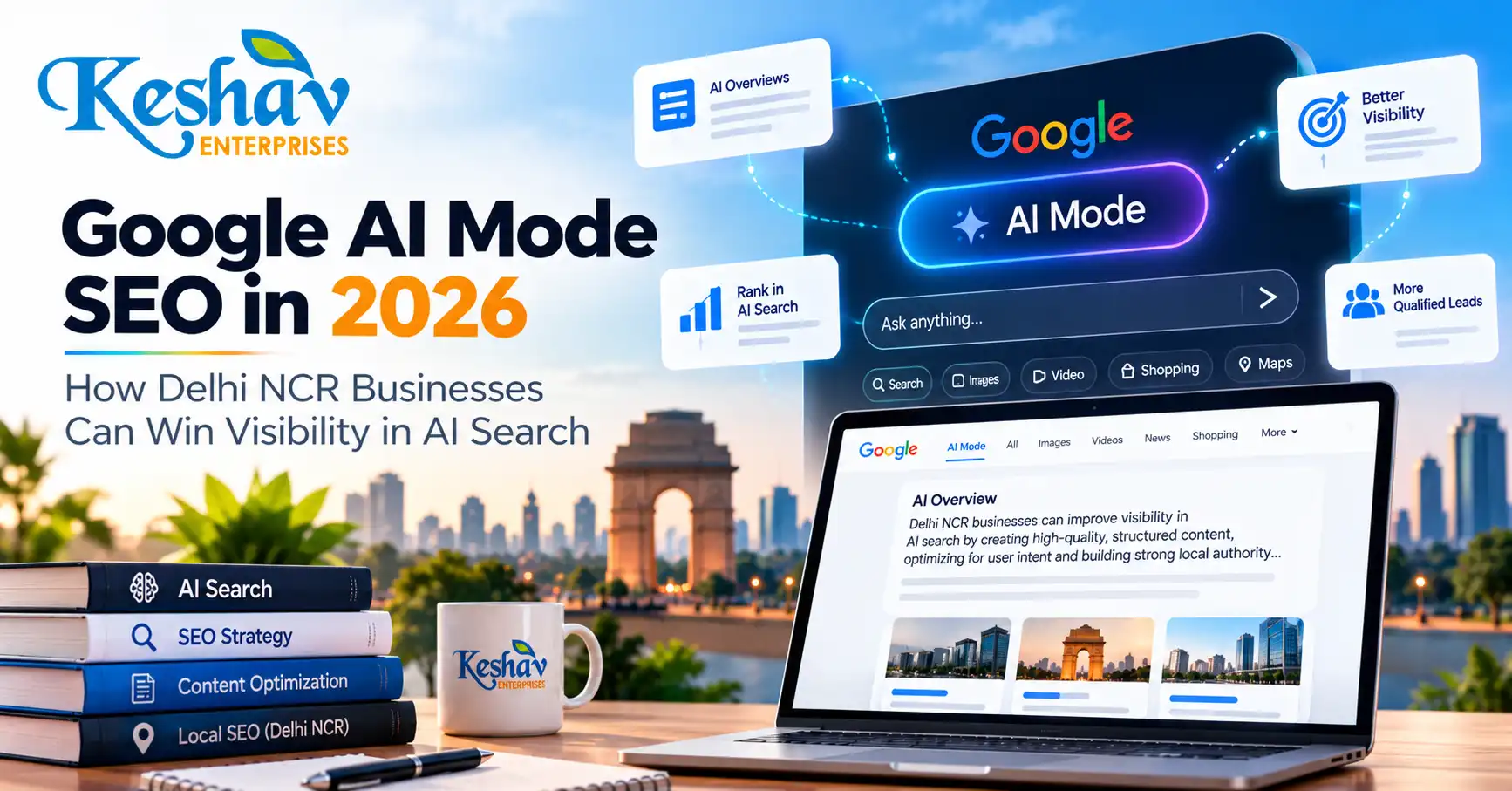
    Google AI Mode SEO in 2026: How Delhi NCR Businesses Can Win Visibility in AI Search

    Google AI Mode SEO in 2026 is not a separate trick or a new type of markup. For businesses in Delhi NCR, the strongest approach is still to build technically accessible pages, publish original and useful answers, make the business entity clear, connect related pages with sensible internal links, and measure whether search visibility produces qualified enquiries.

    The difference in 2026 is that more users are asking longer, more conversational and comparison-heavy questions inside Google Search. AI Overviews and AI Mode can surface supporting links from pages that answer different parts of those questions. That creates an opportunity for businesses that explain their services clearly instead of publishing repetitive keyword pages.

    This guide explains what has actually changed, what Google currently recommends, how local businesses should adapt, and how to measure AI-search visibility without relying on unsupported promises.

    Quick answer: how do you optimize for Google AI Mode in 2026?

    To improve your eligibility for Google AI Mode and AI Overviews, make sure important pages are crawlable and indexable, answer real customer questions directly, publish unique evidence-based content, use descriptive internal links, keep business information consistent, and make important text available in the page content. Google states that its existing SEO best practices continue to apply to AI features and that there is no special AI-specific schema required.

    Google’s current guidance is available in its AI features and your website documentation.

    What changed in Google AI search during 2026?

    Google has continued expanding guidance and measurement around generative search. In May 2026, Google published a new resource focused specifically on optimizing for generative AI experiences while reiterating that useful, original content and normal SEO fundamentals remain the foundation. In June 2026, Google introduced dedicated Search Generative AI performance reporting, and Google stated that these insights had rolled out worldwide by August 31, 2026.

    That means businesses can now approach AI search with better measurement than before. Instead of treating “AI visibility” as a vague agency metric, teams can increasingly connect search visibility with actual impressions, visits, engagement and conversions.

    See Google’s 2026 generative AI optimization resource announcement and its Search Generative AI performance reporting announcement.

    AI Mode SEO vs traditional SEO: what is different?

    Area Traditional search AI-assisted search What businesses should do
    Queries Often shorter and keyword-led More conversational, multi-step and comparative Answer complete questions and decision points
    Discovery Classic search results and rich features Generated answers with supporting sources Create pages that are useful as standalone sources
    Content depth One page may target one main topic Different pages may support different sub-questions Build focused topic clusters instead of duplicate pages
    Technical eligibility Pages need to be crawlable and indexable The same requirement still applies Fix rendering, canonical, sitemap and robots issues first
    Measurement Clicks, impressions, rankings and leads Dedicated generative AI visibility is increasingly measurable Connect visibility with qualified business outcomes

    1. Start with indexability before thinking about AI visibility

    A page that Google cannot crawl or index is not a strong candidate for AI-assisted visibility either. This is especially important for businesses using React, Next.js or headless WordPress.

    • The public URL returns HTTP 200.
    • The main text is available reliably to crawlers.
    • The canonical points to the intended public URL.
    • There is no accidental noindex.
    • Robots rules do not block required crawling.
    • The page appears in the correct sitemap.
    • The page is linked internally from relevant sections.
    • The visible title, headings and metadata describe the same topic.

    If your current website has technical or rendering problems, start with a website development and technical review before scaling content production.

    2. Build content around complete customer questions

    AI-assisted search is useful for queries that previously required several separate searches. A business owner might ask:

    • “Should I invest in SEO or Google Ads first for a new clinic in Delhi?”
    • “How do I improve Google Maps visibility without creating fake location pages?”
    • “Why is my React website indexed slowly even though the WordPress backend has published posts?”
    • “What should I check before hiring an SEO company in Delhi NCR?”

    These are not just keywords. They are decisions. Strong content explains the trade-offs, gives a direct answer early, then expands with examples, limitations and the next action.

    3. Avoid publishing five pages that answer the same question

    One of the easiest ways to weaken a content strategy is to create multiple near-duplicate articles around the same intent. Instead, build a topic cluster in which each page has a distinct purpose:

    • A core SEO services page for commercial intent.
    • A practical AI Mode guide for emerging search behavior.
    • A local SEO guide for map and location-based discovery.
    • A technical indexing guide for React, Next.js and WordPress sites.
    • A comparison article when users need to choose between SEO and paid acquisition.

    4. Strengthen entity clarity

    AI systems and customers both benefit from consistent information about who the business is, what it offers, where it operates and how people can contact it.

    • Keep company name, services and contact details consistent.
    • Explain which markets are genuinely served.
    • Use real project examples only when they can be verified.
    • Clarify what is included and excluded in each service.
    • Support technical claims with primary sources.

    5. Use clear answer-first writing for AEO and AI retrieval

    A useful section should still make sense when extracted from the rest of the article. A practical structure is:

    1. Question-based heading.
    2. Two- or three-sentence direct answer.
    3. Supporting explanation.
    4. Example or comparison.
    5. Relevant internal link or next action.

    6. Create original information that deserves to be cited

    Google’s guidance for AI search emphasizes unique, valuable content rather than commodity text. Useful original value can include:

    • Actual service process.
    • Real technical checklists used during delivery.
    • Original diagrams or screenshots.
    • Clear comparisons between options.
    • Common implementation mistakes.
    • Verified project examples when permission exists.

    Do not invent case studies, testimonials, traffic increases or client results just to make an article look authoritative.

    7. Support text with useful images and visuals

    Google’s AI-search guidance recommends supporting textual content with high-quality images and video where appropriate. A strong featured image should match the article rather than being reused across unrelated posts.

    • Create a unique visual for the article topic.
    • Use a descriptive filename.
    • Add meaningful alt text.
    • Compress the asset for web performance.
    • Avoid keyword stuffing in alt text.

    8. Treat local SEO as part of AI discovery

    Local businesses still need accurate business information, genuine reviews, appropriate service-area content and a useful Google Business Profile. AI search does not replace these fundamentals.

    For a deeper local strategy, read the Local SEO for Delhi Businesses guide or explore local SEO services in Delhi NCR.

    9. Use structured data to clarify content, not to “hack” AI search

    Structured data can help search systems understand content, but it must accurately match what users can see. Google states that there is no special AI-specific schema required for AI Overviews or AI Mode.

    10. Measure AI-search visibility with real business metrics

    In 2026, measurement is becoming more useful because Search Console now provides dedicated generative AI visibility reporting. Track:

    • Generative AI impressions where available.
    • Organic landing-page clicks.
    • Qualified enquiries.
    • Conversion rate by landing page.
    • Search queries with commercial or problem-solving intent.
    • Pages gaining impressions but weak CTR.
    • Pages that remain unindexed after publication.

    11. Build internal links that reflect topic relationships

    Internal links should help a reader continue the journey. Use descriptive anchors and avoid linking the same commercial keyword repeatedly across every article.

    12. Improve conversion experience after the click

    More visibility is not useful if a visitor cannot understand what to do next. Every high-intent page should make the next step obvious through mobile readability, clear service scope, trust-building information, visible enquiry options and simple forms.

    A 30-day Google AI Mode SEO action plan

    Week 1: technical and indexing audit

    • Check status codes, canonical tags and robots directives.
    • Review sitemap coverage.
    • Inspect important URLs in Search Console.
    • Test rendered content on JavaScript-heavy pages.

    Week 2: improve commercial pages

    • Rewrite vague introductions.
    • Add direct answers to common buying questions.
    • Clarify service scope and locations served.
    • Improve CTA placement.

    Week 3: publish one genuinely distinct guide

    • Choose a question customers actually ask.
    • Use primary sources where factual claims matter.
    • Create a unique topic-specific image.
    • Link to related service and educational pages.

    Week 4: measure and refine

    • Review Search Console performance.
    • Check generative AI visibility where available.
    • Identify low-CTR pages.
    • Review indexing issues.

    Frequently asked questions

    Is Google AI Mode SEO different from normal SEO?

    The fundamentals are largely the same. The practical difference is that users are asking more complex questions, so content should answer complete problems rather than only target short keywords.

    Do I need special schema for Google AI Mode?

    No. Google says there is no special schema.org markup required for AI Overviews or AI Mode.

    Can a small Delhi business appear in AI Overviews?

    Potentially, yes. Eligibility depends on the page being indexed and eligible for Google Search with a snippet. Inclusion is not guaranteed.

    Does AI Mode use only pages ranking in the top 10?

    Google does not describe AI Mode as simply copying the classic top ten results. AI features can use related searches and supporting sources across subtopics.

    How should I measure AI search traffic?

    Use Search Console’s generative AI visibility reporting where available, combine it with normal Search performance, and track enquiries, engagement and conversions.

    Can AI-generated content rank?

    The important issue is quality, originality and usefulness rather than whether a tool assisted with drafting.

    Do local SEO and AI SEO work together?

    Yes. Accurate local information, relevant service pages, genuine reviews and strong local content can support overall search understanding.

    Should every service page mention “AI SEO”?

    No. Add AI-search information only where it helps the reader.

    What should I fix first if my website has weak AI visibility?

    Start with crawlability, indexability and content quality.

    How can Keshav Enterprises help?

    Keshav Enterprises can review technical SEO, content structure, local SEO, React/Next.js implementation and conversion flow for businesses across Delhi NCR.

    Final takeaway

    Google AI Mode SEO in 2026 is best treated as an evolution of search, not a replacement for SEO fundamentals. Businesses that make their websites technically reliable, publish original decision-support content, maintain clear entity information and measure real outcomes are in a stronger position across classic search and AI-assisted search.

    If you want a practical review of your current website, contact Keshav Enterprises with your website, target services and priority markets.
  • How Much Does SEO Cost in Delhi NCR in 2026? Pricing, Packages & ROI Guide

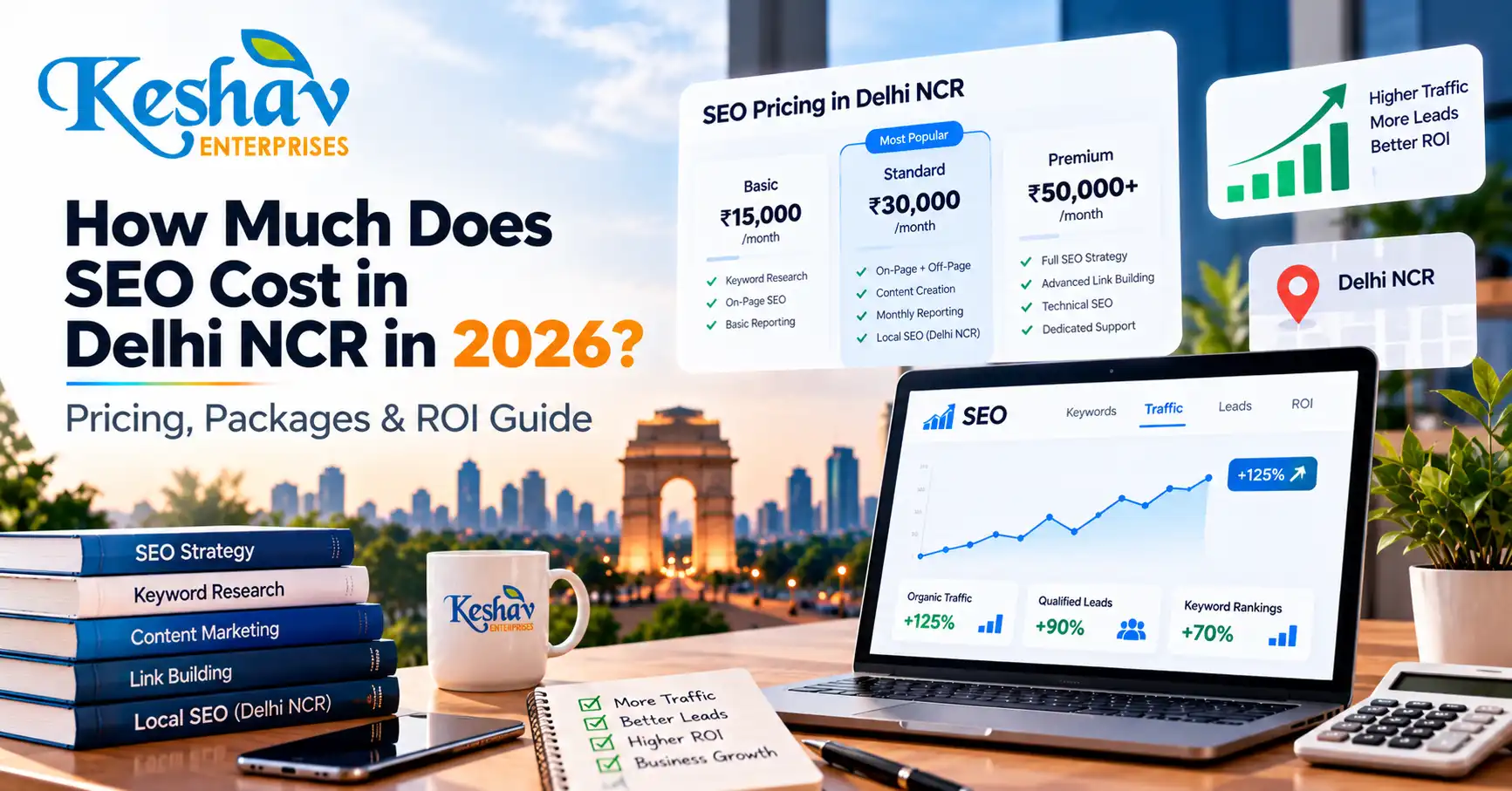
    How Much Does SEO Cost in Delhi NCR in 2026? Pricing, Packages & ROI Guide

    SEO services in Delhi NCR commonly range from around ₹10,000 per month for limited local work to ₹1,00,000+ per month for competitive, multi-service or large-scale campaigns. The price alone, however, tells you very little. Two proposals can both say “SEO” while one includes only basic on-page changes and the other covers technical SEO, content strategy, local search, digital PR, reporting and conversion tracking.

    This guide explains SEO cost in Delhi NCR in 2026, what different budget levels can realistically include, why quotes vary so much, and how businesses in Delhi, Noida, Gurugram, Ghaziabad and Faridabad can compare SEO proposals without choosing purely on price.

    Quick answer: how much does SEO cost in Delhi NCR?

    For planning purposes, many 2026 SEO retainers in Delhi NCR fall into these broad ranges:

    SEO Scope Typical Monthly Budget Usually Suitable For
    Basic / Local SEO ₹10,000–₹25,000 Small local businesses with a limited service area
    Growth SEO ₹25,000–₹60,000 SMEs targeting multiple services or competitive local searches
    Advanced SEO ₹60,000–₹1,00,000+ Competitive industries, ecommerce, multi-location or larger websites
    Enterprise / National SEO Custom scope Large websites, national campaigns and complex technical environments

    These are market-planning ranges, not guaranteed prices. The correct budget depends on your website, competition, number of services, geographic target, content requirement, technical condition and how aggressively you want to grow.

    Why can one SEO company quote ₹10,000 and another quote ₹80,000?

    Because SEO is not a single task. A useful SEO programme can involve technical work, keyword research, content architecture, on-page optimization, local SEO, authority development, analytics, conversion tracking and ongoing strategy.

    A very low quote may cover only a small number of activities. A higher quote may include strategy, development support, content production and broader market coverage. The important question is not “Which quote is cheapest?” but “What work is actually included, who will do it, and how will success be measured?”

    What should be included in a professional SEO package?

    A serious SEO service in Delhi NCR should normally begin with the website and business model rather than a fixed keyword list.

    1. Technical SEO audit

    The website should be checked for crawlability, indexation, canonical issues, redirects, duplicate pages, sitemap problems, broken links, mobile usability and performance issues that can prevent good content from being discovered or understood properly.

    2. Search-intent and keyword mapping

    Keywords should be mapped to the right pages based on what the user is trying to accomplish. A service query, informational query, comparison query and local query should not all be forced onto one page.

    3. On-page SEO

    Important pages need clear titles, headings, copy, internal links, image context and calls to action. On-page optimization is not simply repeating a target phrase; the page should satisfy the search intent and explain the service clearly.

    4. Content strategy

    Supporting content should answer genuine customer questions and build topical depth around your services. This can include guides, comparison articles, buying questions, use cases and local topics.

    5. Local SEO

    Businesses serving defined areas may also need local SEO, including Google Business Profile improvements, location relevance, local pages, reviews, citations and consistent business information.

    6. Authority development

    Search engines need signals that a website and business are credible. Depending on the strategy, this may involve relevant links, mentions, partnerships, local citations, digital PR or other legitimate authority-building activity.

    7. Analytics and reporting

    Reporting should connect SEO activity to business outcomes. Rankings can be useful, but qualified enquiries, organic conversions, important landing-page traffic and search visibility usually matter more.

    SEO pricing by business type

    Local service business

    A clinic, consultant, repair company, interior designer, lawyer or other service provider targeting a limited geographic market may need a smaller scope than a national ecommerce brand. The work often focuses on core service pages, local SEO, Google Business Profile, reviews, location relevance and a focused content plan.

    Typical planning range: ₹10,000–₹30,000 per month depending on competition and scope.

    Growing SME targeting Delhi NCR

    A business targeting several services across Delhi, Noida, Gurugram, Ghaziabad or Faridabad usually needs a stronger technical and content programme, especially when multiple commercial pages are competing against established websites.

    Typical planning range: ₹25,000–₹60,000 per month.

    Ecommerce business

    Ecommerce SEO can require category optimization, product architecture, internal linking, faceted navigation controls, schema, content, technical fixes and ongoing work across a much larger number of URLs.

    Typical planning range: ₹40,000–₹1,00,000+ per month depending on catalogue size and competition.

    National or enterprise business

    Large websites competing nationally can require specialist technical SEO, content operations, digital PR, developer collaboration, analytics and governance across hundreds or thousands of pages.

    Typical planning range: custom, often above ₹1,00,000 per month for substantial campaigns.

    What changes the cost of SEO?

    Competition

    Ranking for a low-competition local service can require far less work than ranking for highly competitive commercial terms such as insurance, loans, software, ecommerce or digital marketing.

    Number of services and locations

    A business targeting one service in one area is very different from a company targeting twenty services across five cities. More genuine search intents usually require more strong pages and a larger supporting content structure.

    Current website condition

    A technically clean website with strong architecture is easier to build on. A site with duplicate pages, poor internal linking, slow templates, broken routing or indexation problems may need development work before content expansion becomes effective.

    Content requirement

    Content depth matters more than publishing a large number of generic articles. Google’s own guidance emphasizes helpful, reliable, people-first content rather than content created mainly to manipulate rankings.

    Website technology

    SEO execution differs across WordPress, Shopify, WooCommerce, React, Next.js and custom websites. A headless or JavaScript-heavy site may need technical SEO and developer support that a simple marketing website does not.

    Authority gap

    If competitors have years of relevant links, mentions and brand demand, closing that gap can require more time and broader off-page activity.

    Does cheaper SEO save money?

    Sometimes a smaller package is exactly what a small business needs. The problem is not the low price itself; the problem is when the scope does not match the goal.

    A ₹10,000 monthly campaign can be reasonable for a limited local requirement. It is unlikely to support the same level of technical work, content production, outreach and account management as a much larger campaign.

    The most expensive SEO is often the campaign that runs for six months without clear deliverables, useful reporting or meaningful improvements.

    What should you ask before hiring an SEO company?

    • Which pages and services will be prioritized first?
    • What technical issues will be audited and fixed?
    • How will keyword intent be mapped to existing or new pages?
    • How much content is included, and who creates it?
    • Does the package include local SEO or Google Business Profile work?
    • How are links or mentions earned?
    • What metrics will be reported each month?
    • Who owns the website content and assets?
    • How will leads and conversions be tracked?
    • What happens if priorities change after the first audit?

    SEO red flags to avoid

    • Guaranteed #1 rankings. No agency controls Google’s organic results.
    • Hundreds of backlinks every month. Volume without relevance or quality can create more risk than value.
    • Identical city pages. Changing only the location name creates weak content.
    • AI-generated filler at scale. Automation without expertise or editorial value rarely creates a useful search asset.
    • No technical access. Some SEO problems cannot be fixed through content alone.
    • No conversion measurement. Traffic without enquiries may not support the business objective.
    • No explanation of deliverables. “30 keywords + 100 backlinks” is not a complete strategy.

    How long should you budget for SEO?

    SEO should generally be treated as an ongoing growth channel rather than a one-month campaign. The timeline depends on the starting condition of the website, competition, content depth, authority and implementation speed.

    Some technical improvements can be crawled and reflected relatively quickly. Competitive commercial visibility usually takes longer because search engines need time to discover changes and reassess the website against other strong results.

    A useful planning mindset is to evaluate progress in stages:

    1. Month 1: audit, strategy, tracking and technical priorities.
    2. Months 2–3: core page improvements, content expansion and local work.
    3. Months 3–6: stronger search visibility, more data and continued authority building.
    4. Beyond 6 months: scale successful topics, improve conversion and expand into additional opportunities.

    This is not a guarantee of rankings or leads; competitive timelines vary considerably.

    How should ROI from SEO be calculated?

    The value of SEO should be measured against qualified business outcomes, not only rankings.

    A simple framework is:

    SEO ROI = (Revenue attributed to organic search − SEO investment) ÷ SEO investment × 100

    But even that calculation needs context. Some buyers visit several channels before converting. Organic search may assist a conversion that eventually comes through direct traffic, WhatsApp, a phone call or a branded search.

    Useful SEO reporting can therefore include:

    • Qualified organic enquiries
    • Organic conversion rate
    • Traffic to service and location pages
    • Search impressions and clicks
    • Growth in non-branded commercial searches
    • Google Business Profile interactions where relevant
    • Landing-page engagement and lead quality
    • Revenue or pipeline influenced by organic search

    Is SEO still worth paying for in 2026 with AI search growing?

    Yes, when the work focuses on making a business easier to discover, understand and trust across modern search experiences.

    Search is changing, but the fundamentals remain valuable: technically accessible pages, clear expertise, useful content, strong entity information, reputable mentions and a website that answers real customer questions.

    Content should now be structured not only for traditional blue-link search but also for AEO, GEO and LLM discoverability. That means direct answers, clear definitions, factual consistency, comparison sections, useful FAQs and strong internal topic relationships.

    How Keshav Enterprises approaches SEO pricing

    Keshav Enterprises does not treat SEO as a fixed list of keywords. The required scope depends on what is actually limiting growth.

    A business may need technical fixes first. Another may need better service pages. A local company may need stronger Google Business Profile and location relevance. An ecommerce website may need category architecture, technical controls and content at scale.

    Our work can connect SEO, local SEO, content strategy, website development and conversion improvement so that traffic is supported by a website capable of turning visibility into enquiries.

    If your current content is thin or inconsistent, our content marketing services in Delhi can support the SEO strategy with structured, useful material built around actual customer questions.

    Frequently asked questions

    How much does SEO cost per month in Delhi?

    Small local campaigns may start around ₹10,000–₹25,000 per month, while broader or more competitive campaigns commonly require ₹25,000–₹60,000 or more. Large ecommerce and enterprise campaigns can exceed ₹1,00,000 per month depending on scope.

    Why do SEO prices vary so much in Delhi NCR?

    Pricing changes with competition, website size, technical condition, number of services and locations, content requirement, authority gap, reporting depth and the amount of specialist work included.

    Is ₹5,000 per month SEO enough?

    It may cover very limited activity, but businesses should check exactly what is included. A low budget cannot realistically support the same level of technical work, content, strategy and authority development as a larger campaign.

    How many months should I pay for SEO?

    SEO is usually an ongoing activity. Many businesses evaluate meaningful progress over several months rather than expecting a complete result in 30 days. The right duration depends on competition and the starting condition of the website.

    Does SEO include content writing?

    Some packages include content and others charge separately. Ask how many pages or articles are included, who writes them, how topics are researched and whether revisions are covered.

    Does SEO include Google Business Profile optimization?

    Not always. If local search is important, confirm that local SEO and Google Business Profile work are explicitly included in the scope.

    Can an SEO company guarantee first position on Google?

    No credible provider can guarantee a specific organic ranking. SEO can improve relevance, technical quality, authority and visibility, but search results are controlled by Google’s systems and competitive conditions.

    Is SEO better than Google Ads?

    SEO is usually better for building long-term organic visibility, while Google Ads can create paid visibility more quickly. Many businesses use both channels together for different stages of demand generation.

    Should I hire an SEO freelancer or agency?

    A freelancer can be suitable for a focused smaller scope. An agency may be more appropriate when the work requires technical SEO, content, development, local SEO and reporting across several specialists.

    Can SEO help my business appear in AI answers?

    No provider can guarantee inclusion in AI-generated answers, but clear, useful, factual and well-structured content can make a business easier for search and answer systems to understand. Strong entity consistency, direct answers, useful FAQs and reputable references also help.

    Get an SEO plan based on your website, not a generic package

    If you are comparing SEO packages in Delhi NCR, start with your website, services, target locations and actual business goals. The right scope should explain what needs to change, what will be done first and how progress will be measured.

    Request an SEO consultation with Keshav Enterprises and share your website, priority services and target areas. We can review the requirement and recommend a practical next step for technical SEO, local search, content or broader digital growth.

  • SEO vs Google Ads in 2026: Which Is Better for Delhi NCR Businesses?

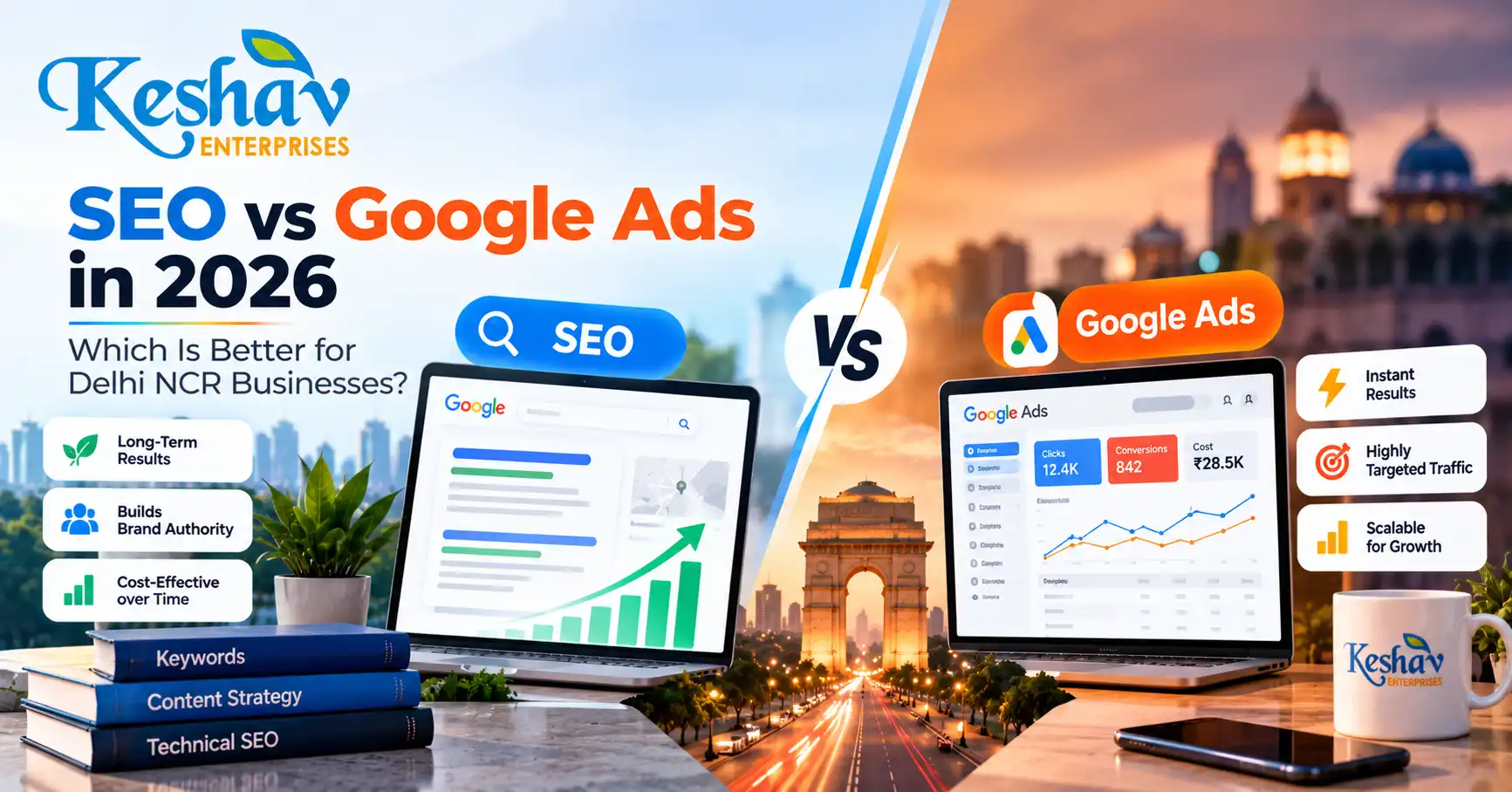
    SEO vs Google Ads in 2026: Which Is Better for Delhi NCR Businesses?

    SEO and Google Ads solve different growth problems. For most businesses in Delhi NCR, SEO is better for building compounding organic visibility over time, while Google Ads is better for generating controlled visibility quickly when people are already searching for a service. The strongest strategy is often not choosing one forever, but using each channel where it has the clearest commercial role.

    This guide compares SEO vs Google Ads in 2026 for businesses in Delhi, Noida, Gurgaon, Ghaziabad and nearby NCR markets. It focuses on lead quality, speed, cost behaviour, trust, local search, measurement and the type of website needed to convert traffic into enquiries.

    Quick answer: SEO or Google Ads — which is better?

    If you need leads quickly, want to test an offer or need visibility for competitive commercial searches, Google Ads management in Delhi NCR can create immediate exposure once campaigns are approved and active.

    If you want to reduce long-term dependence on paid clicks and build a stronger search presence across service pages, local searches and informational topics, SEO services in Delhi NCR are the better long-term foundation.

    For many established businesses, the practical answer is SEO + Google Ads together: use paid search to capture demand now, while SEO builds the organic assets that can keep generating visibility over time.

    SEO vs Google Ads: side-by-side comparison

    Factor SEO Google Ads
    Speed Usually gradual; growth compounds with technical, content and authority improvements. Can generate visibility quickly after campaign setup and approval.
    Traffic cost No fee per organic click, but strategy, content, technical work and authority building require investment. You pay for ad traffic and need active campaign management.
    Best use Long-term discovery, authority, local visibility and broad topic coverage. Immediate demand capture, offer testing, lead generation and time-sensitive campaigns.
    Control Lower direct control over ranking positions and timelines. Higher control over keywords, locations, budgets, schedules and landing pages.
    Compounding value Strong pages can continue earning visibility after they are published and improved. Traffic normally reduces when campaigns stop spending.
    Measurement Track impressions, clicks, rankings, engagement, leads and assisted conversions. Track spend, clicks, conversions, cost per lead, search terms and campaign performance.
    Local targeting Strong for organic local pages, Google Maps support and location relevance. Strong for defined geographic targeting and high-intent local searches.

    What does SEO actually do for a business?

    Search engine optimization improves the technical accessibility, relevance, usefulness and authority of a website so it can earn greater visibility for appropriate searches. Good SEO is not limited to adding keywords to a page.

    A practical SEO programme can include technical auditing, keyword and search-intent mapping, service-page improvement, internal linking, local SEO, content publishing, structured data, image optimization, crawl/indexation fixes and authority development.

    For a service business in Delhi NCR, SEO can help build visibility for searches such as:

    • SEO company in Delhi
    • website development company in Delhi NCR
    • Shopify developer in Noida
    • Google Ads agency in Gurgaon
    • digital marketing agency near me
    • Problem-based searches such as “why is my website not ranking?”

    SEO also supports answer engines and AI-driven discovery when pages are written with clear definitions, useful comparisons, direct answers, consistent business information and strong topic relationships. That is one reason we recommend building content for real user questions rather than repeating one keyword unnaturally.

    What does Google Ads actually do?

    Google Ads allows a business to appear for selected search demand through paid campaigns. A campaign can be structured around keywords, locations, audiences, devices, schedules, budgets and conversion goals.

    The advantage is speed and control. If someone is actively searching for a service, a well-built search campaign can place the offer in front of that person without waiting for an organic page to improve its ranking.

    However, paid traffic does not fix a weak offer or a weak website. If users click an ad and reach a slow, confusing or generic page, the business may pay for traffic without generating enough qualified enquiries. That is why our website development work and PPC planning are connected to landing-page clarity, mobile experience, tracking and conversion paths.

    Which channel generates leads faster?

    Google Ads is normally the faster channel for immediate search visibility. Once the account, campaign, targeting, ads, landing page and tracking are ready, the business can start entering paid auctions for relevant searches.

    SEO is generally slower because search engines need to crawl, understand, evaluate and re-evaluate website changes. Competitive searches may require stronger content, technical fixes, internal linking, local relevance and authority before meaningful organic growth appears.

    This does not make SEO weak. It means SEO and PPC operate on different timelines.

    Which channel is cheaper?

    There is no universal answer. SEO does not charge per click, but useful SEO still requires investment in strategy, content, technical implementation, reporting and sometimes development. Google Ads charges for ad traffic, and competitive sectors can require meaningful budgets to collect enough data and conversions.

    The better question is: which channel produces qualified enquiries at an acceptable acquisition cost? A low-cost click that never becomes a lead is not necessarily better than a more expensive click that produces a valuable enquiry.

    Which is better for trust and credibility?

    Organic visibility can support credibility because users repeatedly encounter a business across service pages, local results, helpful articles and branded searches. Paid ads can also create trust when the landing page is specific, transparent and professionally built.

    Trust is not created by the traffic source alone. It comes from the complete experience: clear positioning, real contact information, relevant services, useful content, strong mobile UX, transparent calls to action and consistent business information.

    SEO vs Google Ads for local businesses in Delhi NCR

    Local competition varies significantly across Delhi, Noida, Gurgaon, Ghaziabad and other NCR areas. A business may rank well in one area and poorly in another because local results depend on relevance, distance, prominence and the searcher’s context.

    For local visibility, SEO should connect the website with accurate business information, strong service pages, genuine local relevance, useful location content and a correctly managed Google Business Profile. Our detailed local SEO guide for Delhi businesses explains this process in more depth.

    Google Ads can complement that strategy by targeting high-intent searches in defined service areas while organic visibility grows.

    When should a business choose SEO first?

    SEO is often the better first priority when:

    • Your website has weak or inconsistent organic visibility.
    • You have several services that need dedicated search-ready pages.
    • Your buyers research extensively before contacting a provider.
    • You want to build long-term topical authority.
    • You depend too heavily on paid traffic.
    • You want stronger local and organic discovery across Delhi NCR.
    • Your site has technical SEO or indexation problems.
    • You already receive enquiries but want more sustainable inbound demand.

    When should a business choose Google Ads first?

    Google Ads can be the better first priority when:

    • You need demand quickly for an active service or offer.
    • You want to validate which search terms generate real enquiries.
    • You are entering a new market and do not yet have strong organic rankings.
    • You have a focused landing page and reliable lead follow-up.
    • You need geographic control across Delhi, Noida, Gurgaon or another service area.
    • You want to measure cost per lead for specific commercial queries.
    • You are running a time-sensitive launch, promotion or campaign.

    When should SEO and Google Ads run together?

    Running both channels together makes sense when a business has enough budget and operational capacity to handle incoming leads.

    A combined strategy can work like this:

    1. Google Ads captures immediate demand. Campaigns target high-intent searches and reveal useful search-term and conversion data.
    2. SEO builds long-term assets. Strong service pages, local pages, technical improvements and useful articles expand organic visibility.
    3. Landing pages improve both channels. Better message clarity, speed, forms and proof can improve paid conversion rates while also strengthening organic usefulness.
    4. Search data informs content. Real query patterns can reveal customer language and new content opportunities.
    5. Brand visibility becomes more resilient. The business is not dependent on only one traffic source.

    A practical 90-day SEO + Google Ads framework

    Days 1–30: fix tracking and foundations

    • Audit the website, analytics and conversion tracking.
    • Identify high-value services and target locations.
    • Map commercial search intent to the correct landing pages.
    • Fix technical issues that block crawling, indexing or conversion.
    • Build or improve the highest-priority PPC landing page.
    • Launch tightly controlled paid search campaigns where appropriate.

    Days 31–60: improve relevance and conversion

    • Upgrade core service-page content.
    • Improve titles, headings, internal links and FAQs.
    • Review Google Ads search terms and exclude irrelevant traffic.
    • Test landing-page messaging and calls to action.
    • Publish one or more supporting articles around real buying questions.
    • Strengthen local SEO signals if location-based demand matters.

    Days 61–90: scale what is working

    • Compare lead quality by campaign, keyword and landing page.
    • Expand organic content around validated customer questions.
    • Improve pages that receive impressions but weak clicks or conversions.
    • Adjust PPC budget toward better-performing intent clusters.
    • Develop relevant authority and local mentions.
    • Review the full journey from search to enquiry, not only traffic.

    How to make your content easier for Google, AI search and LLM systems to understand

    There is no special “LLM keyword” that guarantees citation or ranking in AI answers. The safer approach is to make the website easy to interpret and trustworthy.

    • Answer the main question directly near the top of the page.
    • Use descriptive headings based on real user questions.
    • Explain important terms in simple language.
    • Use comparison tables where they genuinely help.
    • Keep business name, services, location and contact details consistent.
    • Add visible FAQs that answer practical buying questions.
    • Use relevant internal links between related services and guides.
    • Keep claims specific and avoid unsupported guarantees.
    • Use structured data only when it accurately represents visible content.
    • Update important pages when services, pricing models or business details change.

    This approach supports SEO, AEO (Answer Engine Optimization), GEO and LLM discoverability without sacrificing usefulness for human visitors.

    What should Delhi NCR businesses measure?

    Whether you use SEO, Google Ads or both, measure business outcomes rather than vanity metrics.

    • Qualified form submissions.
    • Calls and WhatsApp enquiries where tracked.
    • Conversion rate by landing page.
    • Organic clicks to commercial pages.
    • Search terms that generate qualified leads.
    • Cost per qualified lead from paid campaigns.
    • Location-level visibility for target services.
    • Lead-to-sale quality, not only raw lead count.

    Frequently asked questions

    Is SEO better than Google Ads?

    SEO is better for building compounding organic visibility over time, while Google Ads is better for immediate controlled visibility. The best choice depends on your timeline, budget, website quality, competition and business objective.

    How long does SEO take to work?

    There is no fixed timeline. Technical improvements may be reflected relatively quickly, while competitive commercial rankings can require sustained work over several months. The starting condition of the website, competition, content quality and authority all affect the timeline.

    How quickly can Google Ads generate leads?

    Google Ads can start generating visibility after campaign setup and approval, but lead quality depends on targeting, search terms, bidding, ad relevance, landing-page quality, tracking and follow-up. Fast traffic does not automatically mean profitable traffic.

    Should a small business in Delhi run SEO or PPC?

    A small business should choose the channel that matches its immediate constraint. If it needs leads now and has a clear offer, PPC may be useful. If it needs a stronger long-term web presence, SEO may deserve priority. A smaller combined strategy can also work if tracking and landing pages are strong.

    Can SEO replace Google Ads completely?

    Sometimes, but not always. A business with strong organic visibility may reduce paid dependency, while other businesses still use Google Ads for priority services, new markets, launches or highly competitive terms.

    Can Google Ads improve SEO rankings?

    Paying for Google Ads does not directly buy organic rankings. However, paid campaigns can provide useful search-term and conversion data that helps inform landing pages, offers and content strategy.

    Do I need a new website before starting SEO or Google Ads?

    Not necessarily. An existing website can often be improved. But if the site is slow, confusing, technically weak or difficult to convert on mobile, development improvements may be necessary before scaling traffic.

    What is the best strategy for a service business in Delhi NCR?

    For many service businesses, a strong approach is to build technically sound service pages, local relevance and useful content through SEO while using tightly controlled Google Ads for high-intent searches that justify paid acquisition.

    Need a practical SEO and Google Ads plan?

    Keshav Enterprises provides SEO, local SEO, Google Ads/PPC, website development and conversion-focused digital support across Delhi NCR. We plan each channel around the business goal rather than forcing every company into the same package.

    Request a digital growth consultation and share your website, target services, priority locations and current lead-generation challenges.

  • Local SEO for Delhi Businesses in 2026: How to Improve Google Maps and Local Search Visibility

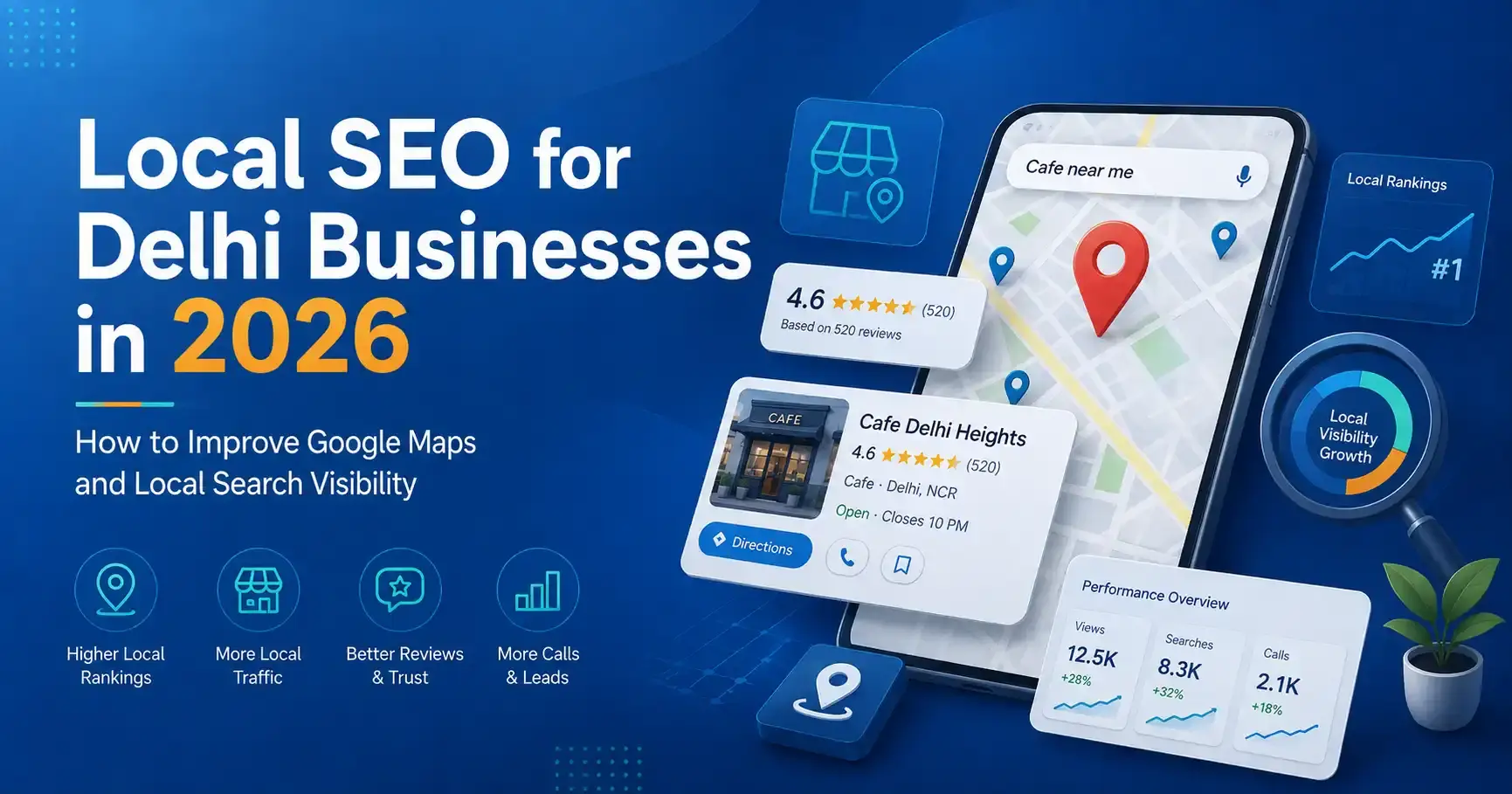
    Local SEO for Delhi Businesses in 2026: How to Improve Google Maps and Local Search Visibility

    Local SEO helps a business become more visible when people search for a service in a specific area or look for nearby providers in Google Search and Maps. For a business serving Delhi NCR, that can include searches such as “website developer in Nehru Place,” “SEO company in Delhi,” “dentist near me,” “interior designer in Noida” or “accountant in Gurgaon.”

    Ranking locally is not about repeating a city name hundreds of times. Google explains that local results are mainly influenced by relevance, distance and prominence. That means a strong local strategy combines an accurate Google Business Profile, a technically sound website, useful location-relevant content, real customer reputation and consistent business information across the web.

    This guide explains a practical approach to local SEO for Delhi businesses in 2026 without fake reviews, doorway pages or keyword stuffing.

    What is local SEO?

    Local SEO is the process of improving a business’s visibility for searches connected to a geographic area. It covers both the website and external local signals such as Google Business Profile, business directories, reviews and local mentions.

    For service businesses, local SEO can influence two important search surfaces:

    • Google Maps / local pack: business profiles displayed for local-intent queries.
    • Organic search: website pages that rank below or around the local results.

    A business can perform differently in Maps and organic search, so the strategy should measure both.

    The three foundations of Google local visibility

    Relevance

    Relevance is how closely the business matches what the searcher wants. Clear categories, services, website pages, profile information and content help search systems understand what the business actually offers.

    Distance

    Distance considers the location of the searcher or the location named in the query. This is why no ethical SEO provider can guarantee the same Maps position for every person across Delhi NCR. A business in Nehru Place may naturally perform differently for users searching from Rohini, Noida or Gurgaon.

    Prominence

    Prominence reflects how established and well known a business appears. Reviews, links, mentions, directories, website authority and broader real-world reputation can contribute to this picture.

    This is why local SEO services in Delhi NCR should never be reduced to editing a Google Business Profile once. The profile and the website need to reinforce each other over time.

    Step 1: make your Google Business Profile accurate and complete

    Start with basic accuracy. The business name should reflect the real-world business name rather than a list of keywords. Choose the most accurate primary category and relevant secondary categories. Add genuine services, business hours, website, phone number and address or service-area information according to how the business actually operates.

    • Business name.
    • Primary and secondary categories.
    • Address or service-area setup.
    • Phone number.
    • Website URL.
    • Regular and special hours.
    • Services or products.
    • Business description.
    • Attributes available for the category.
    • Photos and videos.

    Do not add keywords to the business name unless they are genuinely part of the name used in the real world. Short-term manipulation can create verification or policy problems.

    Step 2: keep NAP information consistent

    NAP means Name, Address and Phone number. The key business information on your website should match the details used on major profiles and directories.

    Perfect character-for-character consistency across every historical directory is not a magic ranking formula, but contradictory information can create user confusion and make it harder for platforms to understand the current business entity.

    On your own website, place verified contact details in predictable locations such as the footer, contact page and relevant structured data. If you move office, update the website and major business profiles promptly instead of leaving old addresses active for months.

    Step 3: create strong service pages before making dozens of location pages

    A common local SEO mistake is creating many thin pages such as “SEO Company Delhi,” “SEO Company South Delhi,” “SEO Company Noida,” “SEO Company Gurgaon” and “SEO Company Ghaziabad” and changing only the city name. These pages offer little value if the service description is otherwise identical.

    Start with comprehensive service pages that explain the problem, scope, process, deliverables, examples and FAQs. Keshav Enterprises, for example, separates its broader SEO services in Delhi NCR from its local SEO service so the intent of each page is clearer.

    Create dedicated city or area pages only when there is enough genuine local information to make them useful.

    Step 4: build location pages that deserve to exist

    A strong location page should not look like a template with one word changed. Useful local elements can include:

    • Services genuinely delivered in that market.
    • Local office or service-area information.
    • Local project examples that can be verified.
    • Travel/service logistics where relevant.
    • Local customer questions.
    • Area-specific industries or requirements.
    • Relevant internal links.
    • A clear enquiry route.

    If you cannot add meaningful local value, one strong Delhi NCR service page may be better than ten weak city pages.

    Step 5: improve your website’s technical foundation

    Google Business Profile work cannot compensate for a broken website. Local visitors frequently move from Maps to the website before calling, especially for higher-consideration services.

    • Pages load correctly on the first visit and direct URL request.
    • The website is mobile responsive.
    • HTTPS works consistently.
    • Important pages are indexable.
    • Canonical URLs are correct.
    • XML sitemap contains canonical pages.
    • Robots rules do not block important content.
    • Images are optimized and have meaningful alt text.
    • Forms and phone links work.
    • Core page templates do not have excessive layout shift.
    • Internal links connect services, locations and supporting articles.

    If your current site is slow, difficult to manage or structurally weak, local SEO may require broader website development improvements before content expansion makes sense.

    Step 6: use local keywords naturally

    Keywords still help clarify page intent, but they should fit the sentence. A page about local SEO in Delhi NCR can naturally mention Delhi, New Delhi, Noida, Gurgaon and Ghaziabad where the business actually serves those areas. Repeating the same phrase in every heading usually makes the page worse for users.

    • Service + city: “SEO company in Delhi.”
    • Service + area: “website developer Nehru Place.”
    • Near-me: “SEO agency near me.”
    • Problem: “why my business is not showing on Google Maps.”
    • Comparison: “best SEO approach for local business.”
    • Informational: “how to optimize Google Business Profile.”

    Build pages around distinct user needs, not around every possible keyword variation.

    Step 7: earn genuine reviews and respond professionally

    Reviews can influence customer confidence and contribute to local prominence. The right strategy is to ask real customers for honest feedback at sensible points in the customer journey.

    Do not buy reviews, create fake reviewer accounts or publish fabricated experiences. In addition to policy risk, fake reviews make it difficult to understand what real customers value or dislike.

    1. Identify legitimate customers after a meaningful service interaction.
    2. Send a direct review request without dictating what they must write.
    3. Respond to positive and negative reviews professionally.
    4. Use feedback to improve recurring service problems.
    5. Track review velocity and themes over time rather than obsessing over one week.

    Step 8: build local authority outside your own website

    Prominence is strengthened when other credible sources mention or link to the business. Relevant opportunities can include industry associations, local chambers, supplier/partner pages, reputable business directories, event coverage, local publications and genuine partnerships.

    The goal is not to submit the same description to hundreds of low-quality directories. Prioritize accurate profiles and sources that real customers or industry participants might actually use.

    Step 9: use structured data to clarify, not manipulate

    Structured data can help search engines understand the entities and relationships on a page. For a local business, appropriate markup may include Organization or LocalBusiness, service information, breadcrumbs and other schema types when they match visible content.

    • Use the real business name, address, telephone and URL.
    • Do not create fake ratings or reviews in schema.
    • Do not add FAQ schema for questions that do not appear on the page.
    • Keep entity identifiers consistent across the site.
    • Make sure structured data describes the page users can actually see.

    Schema is a clarity layer, not a shortcut to ranking.

    Step 10: improve internal linking between local topics

    Search engines and visitors both benefit when related information is connected logically. A local SEO page can link to SEO services, website development, relevant city pages, case studies and educational articles. A city page can link back to the service it represents.

    Avoid adding the same twenty keyword-rich links to every page. Use contextual links where the next page genuinely helps the reader.

    Step 11: publish content that answers local buying questions

    Blogging can support local SEO when the topics connect to actual customer decisions. Instead of generic “10 benefits of digital marketing” posts, build content around questions prospects ask before contacting a provider.

    • How much does website development cost in Delhi NCR?
    • WordPress vs Shopify for a Delhi ecommerce business.
    • Why a website ranks in Noida but not Gurgaon.
    • How to migrate a business website without losing SEO.
    • How to choose an SEO company in Delhi.
    • Google Business Profile optimization checklist.

    Useful content can earn long-tail traffic, support internal linking and give search or AI systems clearer explanations of the business’s expertise.

    Step 12: optimize for AI search by improving factual clarity

    There is no separate “AI keyword stuffing” strategy that makes content automatically appear in answer engines. The safer approach is to make important pages easy to interpret.

    • Direct definitions near the top of the page.
    • Clear headings that reflect real questions.
    • Comparison tables where useful.
    • Short factual summaries.
    • Consistent entity and contact information.
    • Transparent service scope.
    • Meaningful FAQs.
    • Strong internal topic relationships.

    This improves usability for humans while also making the content easier for different search systems to parse.

    A 90-day local SEO framework

    Days 1–30: fix the foundation

    • Audit Google Business Profile.
    • Correct categories, hours and contact details.
    • Audit website indexation and technical errors.
    • Map primary services to the right pages.
    • Fix title, heading and internal-link issues.
    • Confirm analytics and conversion tracking.

    Days 31–60: strengthen relevance

    • Improve key service pages.
    • Create or upgrade valuable location pages.
    • Add accurate local structured data.
    • Publish supporting content around customer questions.
    • Improve image and mobile performance.
    • Start a genuine review-request process.

    Days 61–90: build prominence and measure

    • Improve quality directory profiles and citations.
    • Seek relevant local/industry mentions.
    • Review Google Business Profile performance.
    • Measure calls, forms and qualified enquiries.
    • Compare visibility across target areas.
    • Update content based on actual search and conversion data.

    How should you measure local SEO?

    Ranking is useful, but it should not be the only metric. Track whether visibility produces business outcomes.

    • Organic clicks to service and location pages.
    • Google Business Profile calls and website visits where available.
    • Qualified form submissions.
    • Search queries bringing users to the site.
    • Visibility by location for important services.
    • Conversions from mobile visitors.
    • Review quantity, quality and response process.
    • Pages gaining or losing impressions over time.

    For a Delhi NCR business, location-specific tracking matters because rankings can change significantly based on where the searcher is located.

    Local SEO mistakes to avoid

    • Adding keywords to the Google Business Profile name when they are not part of the real business name.
    • Buying or fabricating reviews.
    • Creating dozens of duplicate city pages.
    • Using fake addresses or virtual locations that do not comply with platform rules.
    • Publishing AI-generated filler with no unique information.
    • Ignoring mobile speed and broken pages.
    • Using inconsistent business details across important properties.
    • Adding structured data that contradicts visible content.
    • Measuring only rankings and ignoring leads.

    Frequently asked questions

    How long does local SEO take in Delhi?

    There is no fixed universal timeline. Results depend on the starting condition of the website and Business Profile, competition, location, reputation, content quality and authority. Technical improvements may be visible quickly, while meaningful competitive growth usually requires consistent work over time.

    Can anyone guarantee a top-three Google Maps ranking?

    No credible provider can guarantee the same top-three position for every user or location. Local results vary based on relevance, distance, prominence, competition and the searcher’s context.

    Do I need a Google Business Profile for local SEO?

    For businesses eligible for a Business Profile, it is an important part of Maps and local visibility. The website remains important because it supports service relevance, trust, organic search and conversion after users click through.

    Should I create a separate page for every Delhi locality?

    Only when each page can offer genuine local value and the business actually serves that market. Near-duplicate pages that change only the place name are not a strong long-term strategy.

    Do reviews help local ranking?

    Reviews contribute to reputation and can influence local prominence and customer decision-making. Focus on genuine customer feedback and professional responses rather than artificial review volume.

    Is LocalBusiness schema enough to rank locally?

    No. Schema helps clarify business information but does not replace profile accuracy, website quality, relevance, reputation, links, content or proximity.

    Want a practical local SEO plan for Delhi NCR?

    Keshav Enterprises supports technical SEO, content architecture, local search optimization and website improvements for businesses across Delhi NCR. The right plan depends on where your current visibility is weak: Google Business Profile, website structure, service relevance, content, reputation or technical performance.

    Request a local SEO consultation and share your website, target services and the Delhi NCR areas you genuinely serve.